When letters alone are not enough
A cup letter on a tag does not tell you how a size will look on a real body. You may be choosing between two sizes, wondering if they are really that different, or noticing that the same label sits differently from person to person.
Here are the ideas that usually clear things up—then you can try them in the tool:
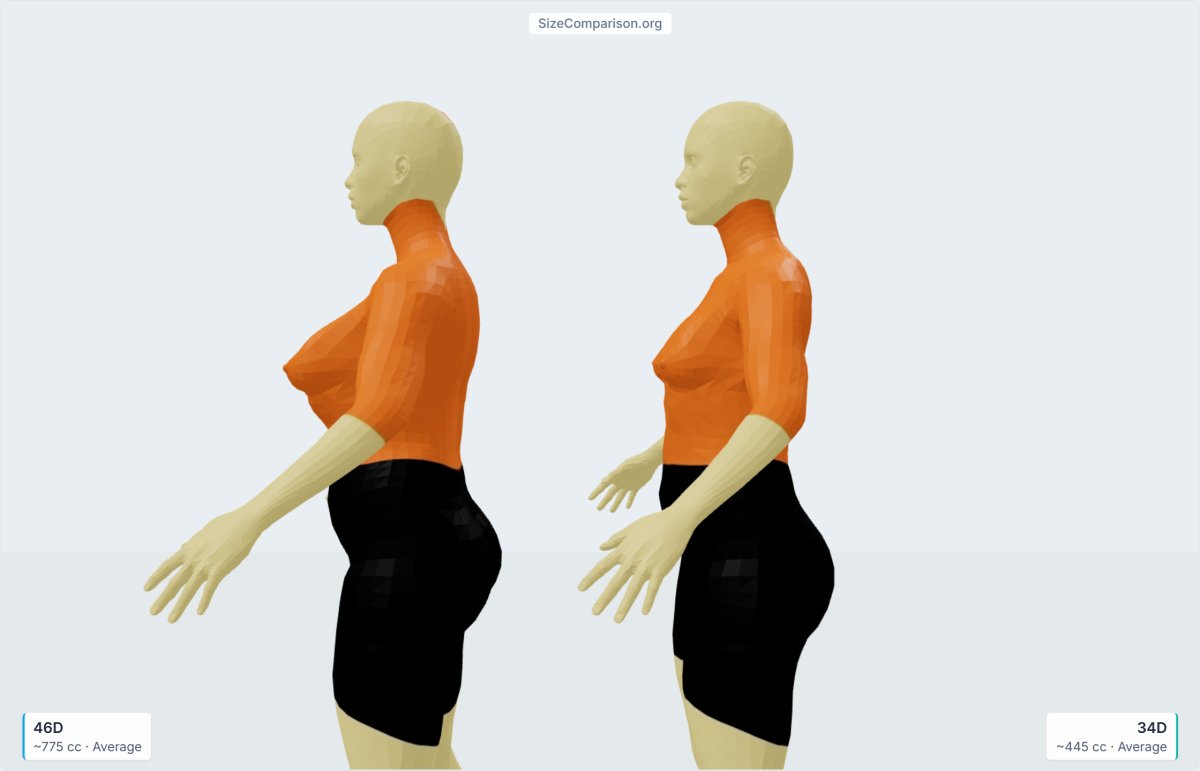
- Line up two sizes (for example B and D) so the gap is easy to see.
- Use sister sizes when the band feels wrong but the cup volume still feels right.
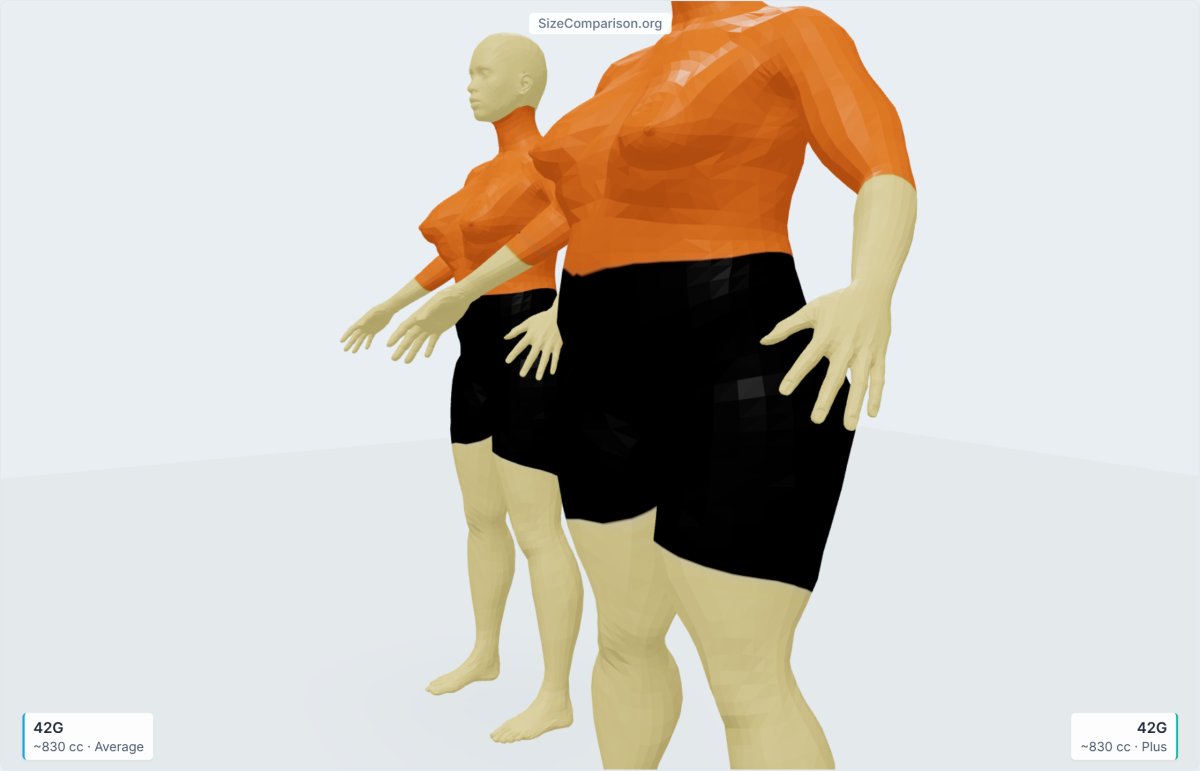
- Keep the same size and change body shape to see why the same letters can look different.
- Estimate a starting size from underbust and full-bust measurements, then compare it visually.
Why seeing two figures helps
Cup letters are relative to the band. A table can list the steps, but it cannot show how the same step looks on a narrower or wider body. In the tool you can change cup size and body shape separately, so the two ideas stay clear.
What a cup letter means—and what it does not
A cup letter describes volume relative to the band—not one fixed look for everyone. A 32D holds less than a 38D, so always read the band and cup together.
On the same band, each letter step adds estimated volume. The table below matches the numbers used in the comparison tool for a 34" US band. Treat them as a guide to relative size, not a brand promise.
Cup volume chart (same band)
Estimated volume for one side on a 34" US band—aligned with the comparison tool.
| Size | Cup | Est. volume (cc) |
|---|---|---|
| 34AA | AA | 225 |
| 34A | A | 280 |
| 34B | B | 335 |
| 34C | C | 390 |
| 34D | D | 445 |
| 34DD | DD | 500 |
| 34DDD | DDD | 555 |
| 34G | G | 610 |
| 34H | H | 665 |
Brands grade differently. Use the steps to compare relative size, then confirm with a try-on.
Sister sizes: similar volume, different band
Sister sizes keep cup volume similar while the band changes: go up one band and down one cup (or the reverse). That is why 34C, 36B, and 32D often feel close in cup space.
| Est. volume (cc) | Sister sizes (US) |
|---|---|
| ≈ 280 | 32B · 34A · 36AA |
| ≈ 335 | 32C · 34B · 36A |
| ≈ 390 | 32D · 34C · 36B · 38A |
| ≈ 445 | 32DD · 34D · 36C · 38B |
| ≈ 500 | 34DD · 36D · 38C · 40B |
Try a sister size when the band digs in or rides up but the cups still feel right. Fit still varies by brand.
How to measure for a size estimate
Use a soft tape. Stand upright and breathe normally. Soft tissue compresses easily—keep the tape snug, not tight.
- Measure underbust snugly around the ribcage; that reading is your band starting point.
- Measure the fullest part of the bust without flattening the tissue.
- Enter both numbers in the tool’s Measure tab, place the estimate on the left or right, then compare with another size or body shape.
Ways to compare in the tool
Start by choosing what you want to keep the same. That sets which difference you will notice first.
Same body — change cups
Both sides share one body shape. Change the band or cup to see the size difference without swapping body types.
Same size — change bodies
Both sides share band and cup. Switch from petite to plus (or athletic to curvy) to see how the same label sits on different frames.
Free setup
Set left and right independently when you want different sizes and different body shapes at once.
From my measurements
Enter underbust and full bust (height optional), then place the estimate on one side. Compare and Measure keep their own sizes, so your tape numbers stay put while you try other options.
US, UK, and EU cup letters
Letter sequences often match through D, then diverge. In the tool, switch the size chart to the labels you know.
| Step | US | UK | EU |
|---|---|---|---|
| 1 | AA | AA | AA |
| 2 | A | A | A |
| 3 | B | B | B |
| 4 | C | C | C |
| 5 | D | D | D |
| 6 | DD | DD | E |
| 7 | DDD | E | F |
| 8 | G | F | G |
| 9 | H | FF | H |
What this page can help with—and what it cannot
Helpful when you want to
- Get a feel for relative cup size and sister sizes.
- Compare the same size on different body shapes before you shop.
- Turn tape measurements into a starting size you can look at next to another option.
It cannot replace
- A brand’s own size chart or an in-person fitting.
- Medical advice, surgery planning, or clinical measurement.
- Guaranteeing how a specific bra style will feel on your body.
For illustration only—not a brand fitting guide or medical advice. Real fit varies by shape, brand, and style.
Try your own sizes next
When you are ready, open the tool and adjust both sides until the difference makes sense:
- Open the tool and choose Same body, Same size, or Free.
- Set band, cup, shape (shallower or more forward), and body type on each side.
- Switch between front, three-quarter, and side views—and zoom to the chest—to compare outlines.
- Copy the link or download an image if you want to save or share the comparison.
Frequently asked questions
- Why does the same cup letter look different on different bodies?
- The same estimated cup volume sits on different torsos. On a narrower frame it can look more prominent; on a wider frame it can look less so. In the tool, choose Same size and switch body shapes to see the change.
- What are sister sizes?
- Sister sizes keep cup volume similar while changing the band: go up one band and down one cup (for example 34C to 36B), or the reverse. When both sides match that relationship, the tool marks them as sister sizes.
- Is a D cup always the same volume?
- No. A 32D holds less than a 38D. Read the band and cup together every time.
- Where should I start in the comparison tool?
- To compare cup steps, use Same body. To see how body shape changes the look, use Same size. If you have tape numbers, open Measure, place the estimate on one side, then compare.
- How accurate is the measurement estimate?
- It uses a common underbust and full-bust difference method as a starting point. Brands grade differently, and shape affects fit. Treat the result as a place to begin, not a final answer.
- Do US, UK, and EU cup letters mean the same thing?
- Not always. They often match through D, then diverge (for example US DDD vs UK E). Switch the size chart in the tool to the system you know.
- Will this match my usual brand’s size?
- Probably not exactly. Use the preview to understand relative size and body scale, then check the brand chart and try the bra on.
- Is this a bra size calculator or a comparison guide?
- You can estimate a starting size from measurements, but the main purpose is to compare sizes on different body shapes—including sister sizes.